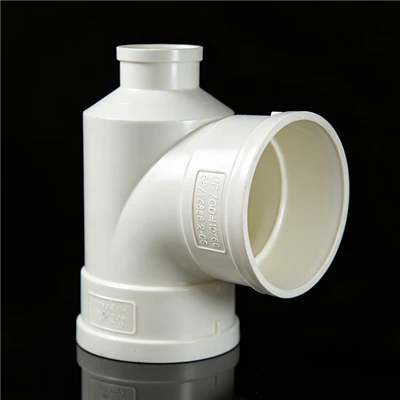
The reason PPR pipes can stay leak-free for a lifetime comes down to hot-melt welding. It is completely different from threaded connections-instead of relying on rubber gaskets to force a seal, it fuses the pipe and fitting into a single piece at the molecular level.
1. The Principle: Molecular Fusion of Thermoplastic Materials
PPR (random copolymer polypropylene) is a thermoplastic. At room temperature, its molecular chains are tightly coiled, making the material hard and stable. When heated to around 260°C, the material turns into a viscous fluid state, and its surface becomes fluid and capable of fusing.
During welding, the outer wall of the pipe and the inner wall of the fitting are heated to this state simultaneously, then quickly pushed together. Once the two molten surfaces are pressed tightly together, the molecular chains diffuse and intertwine. After cooling and solidifying, they become one continuous pipe. The strength of the joint is basically the same as the pipe itself.
2. The Three Steps of Welding
Heating: The heating bit warms both the pipe's outer surface and the fitting's inner surface, creating an even molten layer. Timing depends on pipe diameter-too short and it won't melt through; too long and the material will carbonize.
Insertion: Remove the bit and push the pipe straight into the fitting until it reaches the marked depth. No twisting or tilting-just let the molten surfaces make full contact and compression.
Cooling: Leave it alone after insertion and let it cool naturally. The molecular chains recrystallize while at rest, and the joint strength builds up completely. If you twist or pull the pipe during this stage, the molecular intertwining breaks apart, resulting in a cold weld (false weld).
3. Three Parameters That Determine Quality
Temperature: The standard is 260°C ±5°C. Too low and the molecules aren't active enough to fuse properly; too high and the material degrades and carbonizes, causing a sharp drop in strength.
Time: The larger the pipe diameter, the longer the heating time. This ensures the melt penetrates fully-you can't have it "cooked outside but raw inside."
Pressure: The insertion force must be just right. Too little pressure and the surfaces won't make tight contact, leading to insufficient molecular diffusion. Too much force and the molten material gets squeezed out completely, causing a reduced inner diameter (restriction) that affects water flow.
4. Why Hot-Melt Is the Most Reliable
Threaded connections rely on rubber rings for sealing, which deteriorate over time. Solvent-welded connections depend on chemical adhesives, which carry the risk of interface separation. Hot-melt welding uses no gaskets and no adhesives-the plastic essentially grows into itself. Theoretically, there is zero risk of joint leakage. As long as the operation is done correctly, the joint will last as long as the pipe itself.