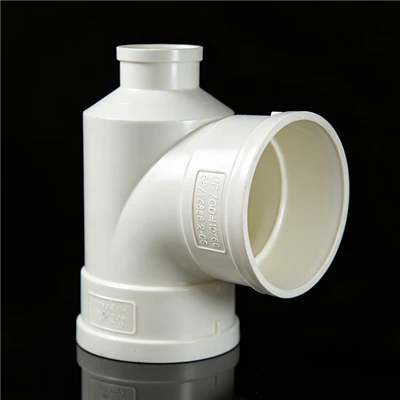
Clogged drains in kitchens and bathrooms are a common problem in both residential and commercial buildings. Most people attribute the issue to excessive hair, food waste, or inadequate daily cleaning. However, industry maintenance statistics show that over 60% of branch pipe blockages occur at tee-joint connections. The structural design of reducing fittings is the hidden key factor affecting drainage smoothness.
I. Most Blockages Occur at Tees-Debris Is Not the Whole Story
In daily unclogging operations, blockages in kitchen and bathroom drainage rarely appear in straight pipe sections; they mostly concentrate at the tee where the branch pipe connects to the main stack.
Standard reducing tees feature a right-angle step at the junction between the branch and main pipes. When water flows through, velocity and direction change abruptly, causing hair, vegetable scraps, and debris to easily catch on the step edge. Accumulation builds over time until the pipe is fully blocked. This is especially problematic in kitchen drainage, where grease-laden water causes stronger adhesion, making debris more likely to clump and accumulate at the tee.
Many households resort to frequent unclogging and install strainers, yet blockages keep recurring. The root cause often lies not in usage habits but in the initial pipe fitting selection.
II. Standard Right-Angle Tees: Structural Defects That Invite Clogging
Many projects still use standard right-angle reducing tees. These fittings are simple to manufacture and low in unit cost, but their structure carries inherent shortcomings.
First, the abrupt cross-sectional change with no transition creates a pronounced right-angle step at the branch-to-main junction, forming a natural snag point for debris. Second, the right-angle inflow causes severe water flow impact and high drainage resistance; as flow velocity drops, debris settles more easily.
In large-diameter-difference scenarios-such as connecting a 50 mm kitchen or bathroom branch pipe to a 110 mm main stack-the step height difference is substantial, making the clogging probability several times higher than that of same-diameter tees. This is also the core trigger for the high incidence of branch pipe blockages in kitchens and bathrooms.
III. Bottle-Shaped Tee: Gradual Flow Channel Reduces Clogging at the Structural Level
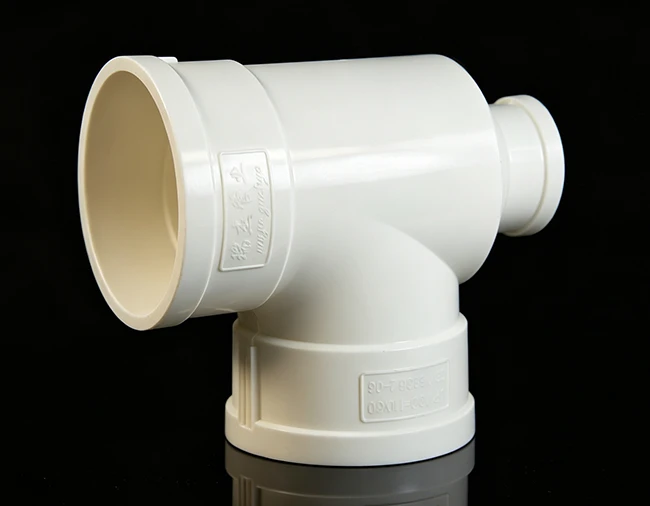
To address clogging at reducing connections, the PVC-U bottle-shaped tee (also known as a bottle-neck tee) optimizes flow channel structure to fundamentally reduce blockage risks.
This fitting adopts a bottle-neck style gradual flow channel, where the branch pipe transitions smoothly and tapers into the main pipe without right-angle steps or abrupt cross-sectional changes. Water flows in smoothly and gently, making it difficult for hair and debris to catch and accumulate. At the same time, the gradual structure causes minimal flow disturbance and lower drainage resistance, preventing backflow even during high-volume discharge.
At drainage points with heavy debris loads-such as kitchens and balconies-replacing standard right-angle tees with bottle-shaped tees can significantly reduce branch pipe clogging probability and lower the frequency of later unclogging.
IV. Anti-Clogging Selection and Installation Considerations
First, select fittings by scenario. For debris-heavy reducing connections such as kitchen drains and balcony rainwater outlets, prioritize bottle-shaped tees. For ordinary bathrooms and branch pipes with minimal debris, selection may be based on cost.
Second, pay attention to installation direction. The branch pipe should connect in the direction of water flow, avoiding reverse insertion that causes flow impact and debris deposition. At the same time, ensure standardized solvent cementing with no protruding glue beads on the inner wall to prevent creating new snag points.
Third, prioritize standard specifications. 110×50 mm and 110×75 mm are the mainstream reducing combinations in building drainage, corresponding to common scenarios where kitchen, bathroom, and balcony branch pipes connect to a 110 mm main stack. These offer high standardization, ample market supply, and mature construction compatibility.
Drainage clog prevention in kitchens and bathrooms is a systemic issue. Daily cleaning and strainer protection serve as supplementary measures, but fitting structure is the foundation. During renovation and retrofit, spending a modest premium on anti-clog fittings such as PVC-U bottle-shaped tees can structurally reduce blockage points-proving more worry-free and economical in the long run.