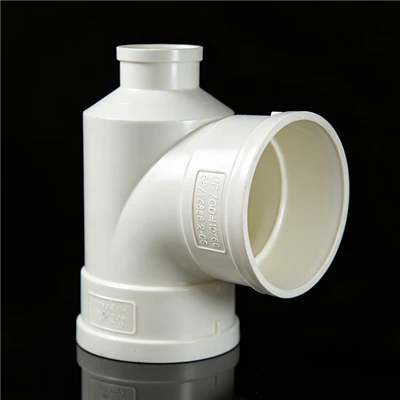
PPR fittings are the core nodes for pipeline connection and direction change. Industry data shows that over 80% of leakage failures occur at fitting joints rather than pipe ruptures. Many buyers prioritize pipes over fittings and select based solely on unit price, resulting in extremely high rework costs later. Choosing the right fitting comes down to four core dimensions: raw material, wall thickness, copper inserts, and application scenarios.
I. Raw Material: Virgin Material is the Foundation; Color Does Not Equal Quality
Raw material determines fitting lifespan and hygiene. The core material is PP-R (Polypropylene Random Copolymer). Color variations are merely due to different color masterbatches and have no bearing on quality. The notion that "white is more hygienic" is a myth.
Inferior products often mix in recycled materials or calcium carbonate, resulting in high brittleness, susceptibility to cracking and creep, easy leakage, and failure to meet hygiene standards-strictly prohibited for drinking water pipelines.
Identification: Check the cross-section-virgin material is fine, uniform, and free of impurities; check the appearance-surface gloss is even with no bubbles or sink marks; weigh it-uniform density and a solid feel. It is recommended to request material test reports when purchasing.
II. Wall Thickness and Pressure Rating: Matching Working Conditions is More Important Than "The Thicker, The Better"
Wall thickness determines pressure-bearing capacity, but uniformity and matching working conditions are more critical than sheer thickness. Common pressure ratings are PN16 (cold water) and PN20 (universal for cold/hot water, 2.0MPa, mainstream). For hot water, high-temperature, and concealed wall installations, PN20+ is mandatory.
Beware of "local thinning": insufficient wall thickness at sockets or the backs of elbows, even over 1mm thinner than national standards. These fittings look thick but have a sharp drop in pressure-bearing capacity and are prone to bursting during water pressure fluctuations.
Selection advice: Measure socket wall thickness with a caliper and observe cross-sectional uniformity. The fitting's pressure rating must match the pipe to avoid the "short-board effect."
III. Threaded Copper Inserts: High-Risk Leakage Zone, Details Determine Lifespan
Threaded fittings with copper inserts (e.g., internal thread elbows, external thread couplings) are the most common leakage points; copper quality directly dictates joint life.
Copper Material: Prefer 62/59 brass (corrosion-resistant, high-strength); avoid scrap copper/nickel-plated iron (prone to rust, thread stripping, leakage); choose lead-free copper for drinking water systems.
Structure: Roots must have barbs/dovetail grooves for mechanical locking with PPR to prevent water pressure from pushing them out; copper inserts should have sufficient wall thickness and feel heavy.
Threads & Craftsmanship: Threads must comply with standards, clear and burr-free, with nickel plating for anti-corrosion; prioritize integrated copper-plastic injection molding to eliminate interface leakage.
IV. Selection Pitfalls: Four Common Misconceptions
1. Focusing only on unit price: Inferior fittings may be cheaper by a few cents, but later wall demolition and pipe replacement costs can be dozens of times the price difference.
2. Judging by color: Color is determined solely by masterbatch and has no direct relation to raw material purity or strength.
3. Mixing brands: Different raw material formulations and melt flow indices lead to varying hot-melt temperature windows, easily causing cold welding and leakage, with hard-to-define liability.
4. Using spring-bent pipes instead of elbows: Forced bending causes wall thinning and stress concentration, leading to cracks; standard elbows with large arc transitions offer more reliable hydraulic and structural performance.
Although fittings account for a low proportion of total value, they are the core weak link in system reliability. Avoid the myths of "cheaper is better" and "thicker is better." Make a comprehensive judgment based on raw material, wall thickness, copper inserts, and application scenarios to select suitable, durable products and prevent a small fitting from ruining a big project.