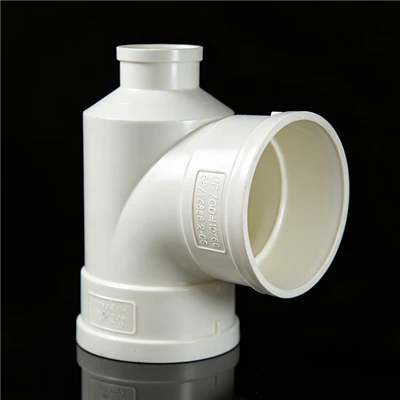
PVC pipes are among the most widely used plastic piping materials in building construction. Through formula modification and comprehensive fitting systems, they adapt to multiple building MEP (Mechanical, Electrical, and Plumbing) systems including drainage, non-potable water supply, electrical protection, ventilation, and communications. Spanning the entire lifecycle from main construction to operation and maintenance, PVC pipes have become foundational materials for pipeline systems thanks to their high adaptability and cost-effectiveness.
I. Core Application Scenarios, Covering All Building MEP Systems
· Building Drainage and Sewage
PVC pipes are widely used for drainage, covering indoor (kitchen, bath, balcony, AC condensate) and outdoor (stormwater-sewage separation, underground non-pressure sewage). Full fittings (3D four-ways, traps, cleanouts, expansion joints) enable complex 3D layouts. Smooth walls resist fouling; one-piece fittings cut leak points. Compliant with GB/T 5836; design temp ≤45°C, special cases need evaluation.
· Non-Potable Water Supply & Reclaimed Water
PVC-U pipes suit reclaimed water, irrigation, fire auxiliary, and non-potable cold water. Drinking water use requires hygiene permits and compliance with GB/T 10002 and GB/T 17219. Compared to metal: no scaling or rust, lighter, faster install, lower cost. Ideal for large-diameter low-pressure supply in public and outdoor areas.
· Electrical Cable Protection
Flame-retardant PVC conduits protect power and low-voltage cables in walls, floors, ceilings. They are insulating, flame-retardant, moisture-proof, acid-alkali resistant, and protect against insects and rodents. This extends cable life and eases maintenance. Available in light, medium, heavy per GB/T 43815.
· Ventilation & Exhaust
Modified PVC vents serve kitchen and bath exhaust, fresh air branches, basements, and industrial anti-corrosion exhaust. They are lighter, easier to install, corrosion-resistant, and quieter than metal ducts, with no anti-rust needed. Note: not for high-temperature fire smoke exhaust; use fire-rated ducts instead.
· Low-Voltage Communication
PVC comm pipes protect low-voltage lines for smart systems, broadband, CATV, and security. Good insulation and anti-EMI. Suitable for underground or concealed wall installation; various fittings support complex layouts.
· Specialized Functions
Also used in rainwater harvesting, wall sleeves, inspection chambers, and underground cable protection. Formula and spec tweaks replace metal pipes in niche scenarios, cutting cost and boosting efficiency.

II. Core Characteristics Supporting Versatility
• High Formula Modifiability: Adjusting formulations can achieve flame retardancy, high impact resistance, weather resistance, hygienic grades, and chemical corrosion resistance to match different system requirements.
• Complete Fitting System: From elbows, tees, and four-ways to traps, expansion joints, and cleanouts, full specification coverage meets any complex pipeline layout need.
• Flexible Installation Methods: Supports socket bonding, rubber ring flexible connection, snap connection, etc., adapting to exposed, concealed, underground, ceiling, and pipe shaft scenarios.
• Low Overall Cost: Moderate material price, high construction efficiency, reduced maintenance under standardized installation and proper media conditions, enabling multi-system coordinated procurement.
III. Differentiated Applications Across Building Types
Residential projects focus on drainage and electrical conduits, emphasizing leak prevention and home-installation adaptability. Commercial and public buildings add large-diameter drainage and low-voltage communication lines, prioritizing system stability and space utilization. Industrial plants emphasize anti-corrosion sewage discharge, industrial ventilation, and cable protection, highlighting corrosion resistance and working condition adaptability.
The versatility of PVC pipes enables coordinated procurement and unified construction of multiple pipe and fitting series in building projects, effectively simplifying the supply chain, reducing overall costs, and providing a cost-effective solution for pipeline systems across all types of construction projects.